Return Policy Traps: 7 Important Clauses Worth Reading First
A return policy is written to sound generous and operate narrowly. Seven clauses that decide whether you get your money back, and where each one hides.
 Madhammer
November 4, 2026 · 9 min read
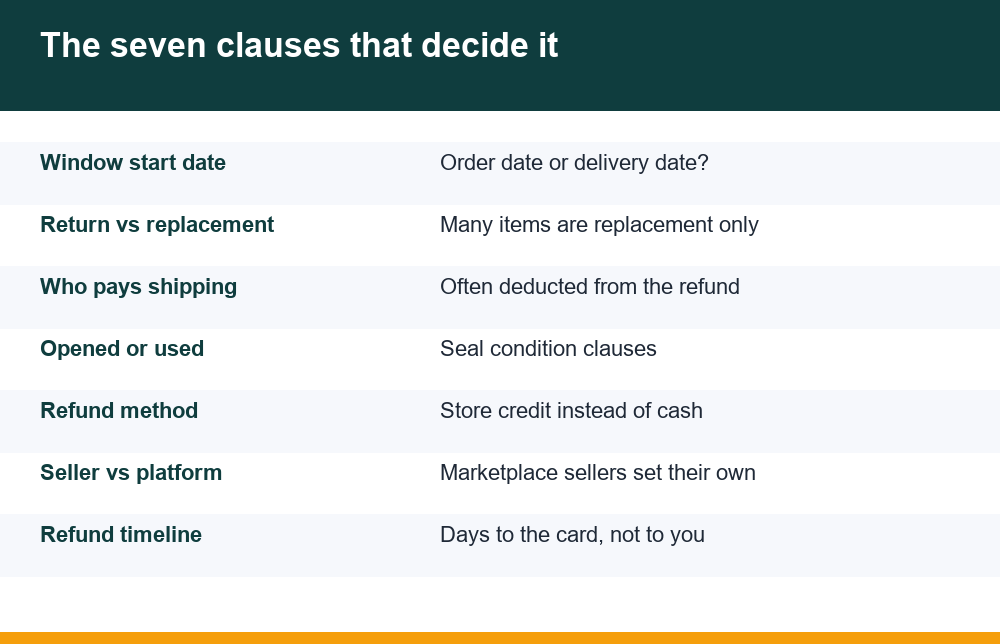
A return policy is a marketing document that happens to be legally binding, and those two jobs pull in opposite directions. The headline exists to remove hesitation at the point of purchase, so it is phrased broadly and placed prominently. The operative terms exist to limit what the business actually owes, so they sit further down in shorter type. Neither is dishonest; they are simply written for different readers. These seven clauses are where the gap between the two usually lives, and knowing them turns a four-minute check before buying into the difference between a refund and a credit note.
Table of Contents
Why the generous headline is not the return policy
30-day returns on a product page is a summary, and summaries omit by design. The operative document is the full terms, which will specify what counts as a return, which items are excluded, what condition is required and who bears the cost.
The gap between the two is not usually a trick. It is the difference between a sentence written to reassure and a clause written to be enforceable, and only one of them is binding.
Where to actually look
The footer link, not the product page. On a marketplace, check the seller’s terms as well as the platform’s, because they are different documents and the stricter one frequently applies. Two minutes before buying beats an argument afterwards.
Clause one: when the window actually starts
A thirty-day window sounds generous until you find it runs from the order date rather than the delivery date. On something that took nine days to arrive, a thirty-day policy has quietly become a twenty-one day one.
Worse combinations exist. A window starting at dispatch, on a pre-ordered item, can expire within days of the product reaching you. Nothing about this is hidden; it is simply stated in a sentence most people never reach.
Check which date the clock runs from, and if it runs from the order, add the delivery estimate to your mental deadline. On anything you are unsure about, open the box and check it the day it arrives rather than the week after.
Clause two: return, replacement or neither
The three are routinely conflated in the headline and are entirely different outcomes. A return gives money back. A replacement gives the same item again. Neither is guaranteed by the other being offered.
Large categories are commonly replacement-only, including many electronics, and the reason is straightforward: a replacement keeps the revenue. If an item arrives faulty and the policy is replacement-only, a refund may simply not be available regardless of how reasonable the request is.
- Check whether the category is listed as refundable or replacement-only before ordering
- Separate the policy for faulty goods from the policy for changing your mind
- Watch for non-returnable categories, which commonly include innerwear, perishables and personalised items
- A replacement usually restarts nothing; the original window often continues to run
That final point catches people out. Receiving a replacement on day twenty-five rarely grants a fresh thirty days, so a second fault can fall outside the window entirely.
Clause three: who pays to send it back
Free returns is a competitive feature rather than a norm, and where it is absent the cost falls on you in one of two ways: paying the courier directly, or having the amount deducted from the refund.
The deduction model is the one worth watching, because it converts a stated refund into a smaller actual one and the difference appears only when the money lands. On a low-value item, return shipping can consume a meaningful fraction of the purchase price, occasionally enough that returning is not worth doing at all.
A reasonable policy distinguishes between a faulty item, where the seller should bear the cost, and a change of mind, where it is more defensible that you do. A policy that charges you for returning something broken is telling you how disputes will go generally.
Clause four: opened, used and the seal
Condition requirements are the most common reason a return is refused, and the wording varies far more than people expect.
Unopened is the strictest and means the packaging seal is intact, which makes inspecting the product impossible without forfeiting the right. Unused allows opening but not using. Original condition with all accessories and packaging is common and reasonable, and it means keeping the box until you are certain.
The practical consequence is simple and worth making a habit: do not discard packaging until the return window has closed. A perfectly good item in perfect condition can be refused because the box went out with the recycling, and arguing that point rarely succeeds because the clause is explicit.
Clause five: how the refund comes back
Money back is not the only possible meaning of a refund, and the alternative is store credit.
Credit keeps the money inside the business, and policies frequently default to it for change-of-mind returns while reserving cash refunds for faulty goods. Some offer credit at a higher value than the cash alternative, which is a genuine choice rather than a trick, provided you intended to shop there again.
| Refund type | What to check |
|---|---|
| Original payment method | Usually the best outcome; check the stated timeline |
| Store credit | Does it expire? Can it be used on sale items? |
| Wallet balance | Withdrawable, or spend-only? |
| Partial refund | What is being deducted, and is it disclosed up front? |
Expiry on store credit is the detail most worth checking. A credit note valid for six months on a shop you visit twice a year is worth considerably less than its face value.
Clause six: marketplace sellers set their own rules
On a marketplace, the platform’s policy and the seller’s policy are separate documents, and which one governs depends on who is actually selling the item.
Items fulfilled by the platform generally follow the platform’s terms and are the simpler case. Items sold and shipped by a third party follow that seller’s terms, which may be shorter, stricter and considerably harder to enforce.
The seller name appears on the product page, usually in small type near the price. It is the single most informative thing on the page for this purpose, and almost nobody reads it before buying. Where a listing is cheaper than everything around it, the difference is sometimes the product and sometimes the terms behind it.
The same instinct applies to offers that look unusually generous, which we went through in our comparison of how to tell a real discount from a staged one.
Clause seven: how long the money takes
Refund timelines are stated as a range and measured from a point that is rarely the one you have in mind.
The clock usually starts when the returned item is received and inspected, not when you handed it to the courier. Inspection can take several days. The stated period then describes when the seller releases the money, after which the card network and your bank each add their own delay.
A policy promising a refund in five to seven working days can therefore reasonably take three weeks end to end without anybody having done anything wrong. Knowing that in advance prevents a great deal of unnecessary chasing, and it also tells you when chasing is actually warranted.
A four-minute check before you buy
Worth doing on anything above a threshold you set yourself, and skipping entirely below it.
- Find who the seller is, especially on a marketplace
- Open the full return policy from the footer, not the product page summary
- Search the page for the words window, shipping, condition and refund
- Check whether your item’s category is excluded or replacement-only
- Note the deadline in your calendar on the day it arrives
The calendar step is the one that pays for itself. Most failed returns are not refused on a technicality; they are simply submitted late, because the window closed while the item sat unopened in a cupboard. A reminder three days before the deadline costs nothing and recovers more money than any amount of arguing afterwards.
One last point worth keeping in proportion: a return policy is the floor, not the ceiling. Statutory consumer rights sit underneath it and cannot be removed by a term in a document, particularly where goods are faulty or not as described. Knowing the policy tells you what the seller has volunteered, which is the fastest route to a resolution, and it is not the limit of what you are entitled to.
If the return is refused
A refusal is not always the end, and the response that works is unglamorous: be specific, be written, and be brief.
Start by establishing which clause is being relied on. A refusal citing a condition requirement is a different conversation from one citing the window, and arguing the wrong point wastes the exchange. Ask directly which term applies, in writing, because a vague refusal frequently does not survive the question.
Where the item was faulty or not as described, say so explicitly and early, since that usually sits under statutory protection rather than under the seller’s return policy and the two are handled differently. Describe the fault factually with photographs rather than characterising the experience.
- Keep everything in writing; a phone call leaves nothing to point at
- Quote the order number, date and the specific clause in every message
- Photograph the item and the packaging before sending anything back
- Escalate to the marketplace only after the seller has refused in writing
- A card chargeback is a last resort, not a first move
On a marketplace, the platform’s own buyer protection scheme usually overrides an individual seller’s refusal, and it is a separate process from the seller conversation. Opening that case too early can close the direct route; leaving it too late can miss the scheme’s own deadline, which is typically shorter than people assume.
One habit worth adopting across all of this: photograph the item as you unbox it, particularly anything expensive or fragile. Thirty seconds at delivery produces dated evidence of the condition it arrived in, which is the single most useful thing to have when a seller suggests the damage happened afterwards.
It is also worth keeping the courier’s proof of return. A parcel that a seller claims never arrived is a common sticking point, and a tracking number showing delivery to their address ends that conversation immediately. Without one, it becomes your word against theirs over an item you no longer hold.
Frequently Asked Questions
When does the return window usually start?
It varies, and the difference matters. Some policies run from the delivery date, others from the order or dispatch date. A thirty-day window starting at order on an item that takes nine days to arrive leaves you twenty-one, which is why checking the start point is worth two minutes.
Can a seller refuse a return because the box is missing?
Frequently yes, where the policy requires original condition with packaging and accessories. The clause is usually explicit, which makes it hard to argue. The practical answer is to keep packaging until the return window has closed.
Is store credit instead of a refund allowed?
Policies commonly offer credit for change-of-mind returns and cash refunds for faulty goods. Where credit is offered, check whether it expires and whether it can be used on sale items, since a short-dated credit note is worth less than its face value.
Who pays return shipping?
It depends on the policy and on why the item is going back. Free returns is a competitive feature rather than a standard. Watch for costs deducted from the refund rather than charged separately, since that reduces the amount you actually receive.
Why is my refund taking so long?
The clock usually starts when the item is received and inspected, not when you posted it, and the card network and your bank each add time after the seller releases the money. A stated five to seven working days can reasonably become three weeks end to end.
{"@context": "https://schema.org", "@type": "FAQPage", "mainEntity": [{"@type": "Question", "name": "When does the return window usually start?", "acceptedAnswer": {"@type": "Answer", "text": "It varies, and the difference matters. Some policies run from the delivery date, others from the order or dispatch date. A thirty-day window starting at order on an item that takes nine days to arrive leaves you twenty-one, which is why checking the start point is worth two minutes."}}, {"@type": "Question", "name": "Can a seller refuse a return because the box is missing?", "acceptedAnswer": {"@type": "Answer", "text": "Frequently yes, where the policy requires original condition with packaging and accessories. The clause is usually explicit, which makes it hard to argue. The practical answer is to keep packaging until the return window has closed."}}, {"@type": "Question", "name": "Is store credit instead of a refund allowed?", "acceptedAnswer": {"@type": "Answer", "text": "Policies commonly offer credit for change-of-mind returns and cash refunds for faulty goods. Where credit is offered, check whether it expires and whether it can be used on sale items, since a short-dated credit note is worth less than its face value."}}, {"@type": "Question", "name": "Who pays return shipping?", "acceptedAnswer": {"@type": "Answer", "text": "It depends on the policy and on why the item is going back. Free returns is a competitive feature rather than a standard. Watch for costs deducted from the refund rather than charged separately, since that reduces the amount you actually receive."}}, {"@type": "Question", "name": "Why is my refund taking so long?", "acceptedAnswer": {"@type": "Answer", "text": "The clock usually starts when the item is received and inspected, not when you posted it, and the card network and your bank each add time after the seller releases the money. A stated five to seven working days can reasonably become three weeks end to end."}}]}