How Does Cashback Work: 5 Essential Mechanics Behind Every Offer
How does cashback work in practice? A plain breakdown of who funds it, how caps and exclusions shrink it, and why an advertised 5% often lands near 0.9%.
 Madhammer
October 21, 2026 · 14 min read
If you want to know how does cashback work without the marketing layer, the honest answer is that cashback is not a discount and not a gift — it is a small share of a payment fee being handed back to you, and whoever funds that share sets every rule about whether you actually receive it. Bank pages describe cashback as a benefit. That framing is not wrong, but it is useless for predicting your payout. What predicts your payout is the funding chain: who pays, what they cap, what they exclude, and how the money reaches you.
This breakdown traces that chain end to end, then runs a single ordinary month of spending through it to show why an advertised 5% can land closer to 0.9%. No tips, no systems, no recommendations — just the arithmetic, including the parts that are unflattering.
Table of Contents
How Does Cashback Work: The Short Answer
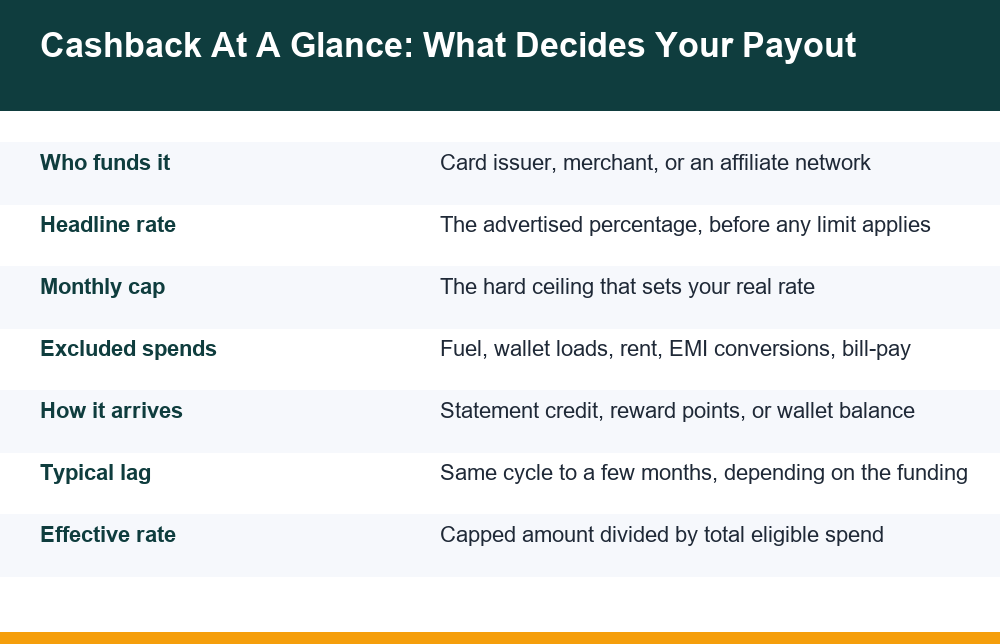
Every card or app payment carries a fee paid by the merchant to the payments chain. A slice of that fee reaches the entity that issued your card or referred the sale. Cashback is that entity giving part of its slice back to you, because keeping you transacting on its rails is worth more than the slice itself. That is the whole mechanism in one sentence.
Two consequences follow immediately, and they explain almost every complaint people have. First, cashback can only exist where a fee exists. Where the payment carries little or no fee — certain bill categories, wallet top-ups, some payment routes — there is nothing to share, which is why those categories are so often excluded. Second, the funder is spending real money, so it protects itself with a ceiling. The headline percentage is a marketing number. The ceiling is the operative number.
So when someone asks how does cashback work, the practical answer is a three-part formula: eligible spend, multiplied by the rate, then truncated at the cap. Most people only ever read the middle term. The first and third terms are where the money goes missing. A fourth condition sits underneath all three: the payout stays provisional until the sale is final, so a cancelled or refunded order takes the cashback with it.
The rest of this piece unpacks those terms in order, because they are not independent. The funding source determines the cap. The cap determines your effective rate. The exclusion list determines what counts as eligible in the first place. Change the funder and all three change with it.
Who Actually Funds The Cashback
Answering how does cashback work for your own account starts here, because there are three common funding routes and identifying which one you are dealing with tells you more than any comparison table.
Issuer-funded cashback
The card issuer pays from its share of transaction economics. This is the most predictable route: the terms sit in the card’s own schedule of charges, the cap is a fixed monthly or cycle figure, and the credit appears on your statement on a known schedule. It is also the most heavily capped, because the issuer is funding it from a thin margin across millions of transactions.
Merchant-funded cashback
A specific brand or category funds an elevated rate to pull volume toward a particular payment method during a particular window. These are the 5% and 10% headline numbers. They are nearly always time-boxed, often capped per transaction rather than per month, and frequently limited to one redemption per customer. The generosity is real but narrow — it is a customer-acquisition cost with an end date.
Affiliate-network cashback
A cashback site or app earns a commission for referring your purchase and passes part of it to you. Here your payout depends on a tracking event firing correctly and a commission actually being confirmed by the retailer, which is why these balances sit “pending” for weeks and why a returned order claws the amount back. If the tracking link was broken, overwritten by another referral, or stripped by a browser setting, the commission never existed and there is nothing to pass on.
If you have ever watched an expected amount simply fail to arrive, the usual explanation is a broken link in this chain rather than anything you did wrong — we walk through the diagnosis in our breakdown of what to check when cashback does not get credited.
The paperwork usually reveals the route. An amount described in a card’s own terms and settled on the statement is issuer-funded. One tied to a named brand, a date range and a per-transaction ceiling is merchant-funded. One sitting in a third-party app’s balance with a status like pending or confirmed is affiliate-funded. A single purchase can touch two routes at once, and the two settle on different timelines with different cancellation rules.
Caps: Where A 2% Card Quietly Becomes 0.4%
A cap is a hard ceiling on how much cashback a category or card will pay in a stated period. It is the single most consequential number in the terms, and it is the number most rarely shown in advertising. The reason is simple: a cap converts a percentage into a flat amount for anyone who spends past it, and the higher your spending, the worse your effective rate becomes.
Take an ordinary structure: 2% on online spends, capped at Rs 750 per month. Up to Rs 37,500 of online spend you genuinely earn 2%. Beyond that point the cashback stops moving while your spending keeps climbing, so every additional rupee earns nothing. The advertised rate has not changed. Your rate has.
| Monthly online spend | Cashback at 2% | Paid after Rs 750 cap | Effective rate |
|---|---|---|---|
| Rs 10,000 | Rs 200 | Rs 200 | 2.00% |
| Rs 25,000 | Rs 500 | Rs 500 | 2.00% |
| Rs 37,500 | Rs 750 | Rs 750 | 2.00% |
| Rs 75,000 | Rs 1,500 | Rs 750 | 1.00% |
| Rs 1,87,500 | Rs 3,750 | Rs 750 | 0.40% |
That final row is the point. The same card, the same unchanged 2% headline, delivers 0.40% to a heavy spender. Nothing was mis-sold and no term was hidden — the arithmetic simply was not done for you. Anyone asking how does cashback work on a card they already hold should therefore start with the cap rather than the rate: the useful question is never “what is the percentage” but “what is the ceiling, and where does my monthly spend sit relative to it”.
Caps also stack in ways that are easy to miss. A card may carry a per-category cap, a per-transaction cap and an overall monthly cap at once, and the smallest binding one wins. Some reset on the statement cycle rather than the calendar month, so a purchase made on the 29th may fall into a different bucket than you assumed. And a ceiling expressed per transaction behaves nothing like one expressed per month.
Excluded Transactions: The Spends That Never Count
Exclusions are not arbitrary. They follow the funding logic: where the payment carries a thin fee, or where the transaction is really a transfer of money rather than a purchase, there is no margin to share. Once you see it that way the lists stop looking random.
Commonly excluded or reduced across the market:
- Fuel — usually handled under a separate surcharge arrangement rather than a cashback one.
- Wallet loads and prepaid top-ups — storing value is not spending it, and the economics do not support a payout.
- Rent and large property-related payments — thin-margin, high-ticket, and a common target of gaming.
- Insurance premiums — frequently carved out entirely or paid at a much lower rate.
- EMI conversions — converting a purchase to instalments typically re-prices the transaction and removes it from the eligible pool.
- Government and institutional payments — including many fee and utility categories carrying little or no fee to share.
- Cash withdrawals, balance transfers and fee or interest charges — never purchases, so never eligible.
- Cancelled or returned orders — the underlying sale reversed, so the payout reverses with it.
One exclusion category deserves separate mention because it surprises people most: paying one card’s outstanding balance from another account. Programmes differ on whether such a payment counts at all, and the treatment has changed over time at various issuers, so if this is a meaningful part of your monthly volume it is worth reading our notes on how card bill payments are treated for rewards before assuming anything accrues.
Exclusions are also where category coding does the real work. Your payout does not depend on what you believe you bought; it depends on the merchant category code the acquiring side attached to the transaction. A supermarket inside a department store may code as a department store. A standalone pharmacy may code as a general retailer. Two visually identical purchases can land in different categories, and no amount of arguing changes the code after the fact.
A quieter kind of exclusion sits in the eligibility wording rather than the category list: offers restricted to new customers, to a first transaction, to one redemption per card, or to a minimum basket value. None of these read as exclusions, but each removes a transaction from the eligible pool just as completely as a carve-out would — which is why how does cashback work on paper and in your statement can differ.
Credit On The Bill Or Cash In Your Account
The word “cashback” implies cash. Often it is not, and part of knowing how does cashback work is knowing which of three delivery shapes you are being paid in, because they are not interchangeable.
Statement credit is the most common on the card route. The amount is netted off your next bill — it reduces what you owe rather than appearing as money you can move. If you were planning to spend it elsewhere, you cannot. It only has value if you were going to pay that bill anyway, which in practice you were.
Reward points or a branded balance adds a conversion step, and that step is where value leaks. Points may carry an expiry, a minimum redemption threshold, a redemption fee, or a conversion ratio that is not one-to-one with rupees. A “5% back in points” offer is worth 5% only if the points convert at face value and you actually redeem them before they lapse. Many do not.
Transferable balance — money released to a bank account or wallet — is the only shape that behaves like cash, and it typically carries the longest wait and the strictest confirmation process, because the funder wants the underlying sale settled and past its return window first. These balances also tend to carry a minimum withdrawal threshold, so a trickle of small amounts can sit unreachable until the total crosses the floor.
This is also the cleanest line between cashback and an upfront price reduction. An instant discount changes what you pay at checkout: it is certain, immediate, and unaffected by caps or tracking. Cashback is a conditional promise of a later credit. Those are genuinely different products wearing similar labels, and we compare them side by side in our piece on instant discounts versus cashback at checkout.
Timing: When The Amount Actually Lands
Delay is structural rather than incidental. Every funder wants the underlying sale to be final before parting with money, and final means the payment has settled, the return window has closed, and in the affiliate case the retailer has confirmed the commission. The longer that chain, the longer the wait. Roughly how the three routes behave, with the caveat that each programme publishes its own schedule and those schedules change:
- Issuer-funded — usually credited within the same or the following statement cycle, because the issuer already holds the transaction record and needs nobody’s confirmation.
- Merchant-funded — often a stated window after the offer period closes, since the funder reconciles the whole campaign at once rather than transaction by transaction.
- Affiliate-funded — the longest and least predictable, because the amount confirms only after the retailer validates the sale and the return period expires, and it can be cancelled at any point before that.
Two consequences follow. A missing amount and a late amount look identical for weeks, so there is usually no way to tell them apart until the published window has passed. And pending is a status, not a balance: an amount shown as pending has not been earned, it is a claim that may still be withdrawn. Part of understanding how does cashback work is accepting that the record you see in an app is provisional until the funder says otherwise.
One Worked Month: 5% Advertised, 0.9% Received
Abstract rules persuade nobody. So here is one ordinary month of spending — illustrative figures, but a structure anyone will recognise — run through an offer advertising “up to 5% cashback” with a Rs 500 monthly cap on the elevated category and 1% on everything else.
| Spend | Amount | Treatment | Cashback |
|---|---|---|---|
| Online shopping (elevated category) | Rs 18,000 | 5% but capped at Rs 500 | Rs 500 |
| Groceries | Rs 9,000 | Base 1% | Rs 90 |
| Dining and travel | Rs 6,000 | Base 1% | Rs 60 |
| Fuel | Rs 4,000 | Excluded | Rs 0 |
| Wallet top-ups | Rs 3,000 | Excluded | Rs 0 |
| Insurance premium | Rs 8,000 | Excluded | Rs 0 |
| Rent payment | Rs 15,000 | Excluded | Rs 0 |
| One purchase converted to EMI | Rs 12,000 | Removed from eligible pool | Rs 0 |
| Total | Rs 75,000 | Rs 33,000 eligible | Rs 650 |
Rs 650 on Rs 75,000 of spending is 0.87% overall, and 1.97% on the eligible portion. Against the advertised 5% it is a fraction. Nothing here is a trick: the cap took Rs 400 that the headline rate implied, and exclusions removed Rs 42,000 of spend from consideration before the rate was ever applied. Notice which lever moved more. The cap cost Rs 400; the exclusions cost several times that, because they removed spending from the calculation entirely before any percentage touched it.
Run this calculation once on your own last statement and you will know your real rate, which is the only rate that matters. It is usually well below the headline figure. That is not a scandal; it is what a margin-funded payout looks like once you account for the ceiling and the carve-outs, and it explains why the same card pays very different effective rates to two people with identical monthly totals but different spending mixes.
It is also why no amount of clever routing turns cashback into income. The funder sets the cap precisely so that it cannot. Understanding how does cashback work is useful for deciding which payment method to use for a purchase you were already making. It is not a way to make money, and anyone presenting it as one is selling something.
Mistakes That Cost People Their Cashback
Most lost cashback traces to a handful of repeating errors rather than to bad luck.
- Reading the rate and skipping the cap. The cap sets your effective rate the moment your spending exceeds it. Find it first.
- Assuming category membership. Eligibility follows the merchant category code, not your intuition about what kind of shop it was.
- Converting an eligible purchase to EMI afterwards. This commonly re-prices the transaction and drops it out of the eligible pool entirely.
- Letting points expire. A payout delivered as points and never redeemed is worth exactly zero, however good the headline rate was.
- Treating pending as earned. On the affiliate route an amount is only yours once the retailer confirms the commission and the return window closes.
- Ignoring a minimum withdrawal threshold. A transferable balance below the floor is not spendable money, and small amounts can sit there indefinitely.
- Spending more to chase a payout. At around 1% effective, an extra purchase made only to “unlock” cashback costs far more than it returns.
- Trusting an unsolicited cashback message. A real payout is never contingent on you approving a collect request, entering a PIN, installing a screen-sharing tool or clicking a link sent by a stranger.
That last point is worth its own warning, because the cashback vocabulary is heavily borrowed by fraud. The pattern is consistent: a message claims a pending cashback amount, then asks you to complete a step to release it. Genuine cashback is credited by the funder without any approval action from you — money moves toward you, and nothing you authorise is required to make that happen. Any request that reverses the direction of the transaction, asks for a PIN or one-time code, or pushes you to install remote-access software is an attempt to take money, not to give it.
If you encounter one, consumers in India can raise a grievance and read consumer advisories through the National Consumer Helpline portal, which is run as a public grievance service rather than a commercial one.
A short honesty note to close this section: every payment product discussed here carries costs that can exceed any cashback earned, interest and fees among them. Cashback is a rounding adjustment on spending you were doing anyway. It is never a reason to spend.
Frequently Asked Questions
What is the difference between cashback and a discount?
A discount cuts the price at checkout and is certain. Cashback is a later, conditional credit that can be capped, excluded, delayed or reversed if an order is cancelled. At the same percentage on the same purchase, the upfront discount is the more reliable of the two because nothing further has to go right after you pay.
Does cashback come as cash or as a credit on my bill?
On card products it usually arrives as a statement credit that is netted off your next bill rather than deposited as money you can move. Some programmes pay reward points that must be redeemed, and some app or wallet routes release a transferable balance, often with a minimum withdrawal threshold. Confirm which shape applies before treating the amount as spendable.
Is there a monthly limit on how much cashback I can earn?
Almost always. Limits can be per transaction, per category, per statement cycle or an overall monthly ceiling, and more than one can apply at once with the smallest one binding. Because the cap converts a percentage into a flat amount for anyone spending past it, it matters more than the advertised rate.
Which transactions are excluded from cashback?
Commonly fuel, wallet and prepaid top-ups, rent, insurance premiums, EMI conversions, many government and institutional payments, cash withdrawals, balance transfers, and any fees or interest charged to the account. Returned or cancelled orders reverse the payout. Lists vary by programme and are revised, so re-read the current terms.
Is cashback taxable in India?
It depends on the amount, how the provider characterises it and your own overall tax position, so no single answer fits every reader. Small statement credits on personal spending are not treated the same way as large or business-related receipts. Since the treatment turns on individual facts, check with a qualified tax professional or the provider’s own disclosure; we do not give tax advice.
Why is my cashback less than the advertised percentage?
Three causes explain nearly all shortfalls: a monthly cap truncated the amount, some of your spending sat in an excluded category, or a points conversion paid out below face value. Totalling your own eligible spend against the cap for one statement period usually identifies the cause quickly.
{"@context": "https://schema.org", "@type": "FAQPage", "mainEntity": [{"@type": "Question", "name": "What is the difference between cashback and a discount?", "acceptedAnswer": {"@type": "Answer", "text": "A discount cuts the price at checkout and is certain. Cashback is a later, conditional credit that can be capped, excluded, delayed or reversed if an order is cancelled. At the same percentage on the same purchase, the upfront discount is the more reliable of the two because nothing further has to go right after you pay."}}, {"@type": "Question", "name": "Does cashback come as cash or as a credit on my bill?", "acceptedAnswer": {"@type": "Answer", "text": "On card products it usually arrives as a statement credit that is netted off your next bill rather than deposited as money you can move. Some programmes pay reward points that must be redeemed, and some app or wallet routes release a transferable balance, often with a minimum withdrawal threshold. Confirm which shape applies before treating the amount as spendable."}}, {"@type": "Question", "name": "Is there a monthly limit on how much cashback I can earn?", "acceptedAnswer": {"@type": "Answer", "text": "Almost always. Limits can be per transaction, per category, per statement cycle or an overall monthly ceiling, and more than one can apply at once with the smallest one binding. Because the cap converts a percentage into a flat amount for anyone spending past it, it matters more than the advertised rate."}}, {"@type": "Question", "name": "Which transactions are excluded from cashback?", "acceptedAnswer": {"@type": "Answer", "text": "Commonly fuel, wallet and prepaid top-ups, rent, insurance premiums, EMI conversions, many government and institutional payments, cash withdrawals, balance transfers, and any fees or interest charged to the account. Returned or cancelled orders reverse the payout. Lists vary by programme and are revised, so re-read the current terms."}}, {"@type": "Question", "name": "Is cashback taxable in India?", "acceptedAnswer": {"@type": "Answer", "text": "It depends on the amount, how the provider characterises it and your own overall tax position, so no single answer fits every reader. Small statement credits on personal spending are not treated the same way as large or business-related receipts. Since the treatment turns on individual facts, check with a qualified tax professional or the provider's own disclosure; we do not give tax advice."}}, {"@type": "Question", "name": "Why is my cashback less than the advertised percentage?", "acceptedAnswer": {"@type": "Answer", "text": "Three causes explain nearly all shortfalls: a monthly cap truncated the amount, some of your spending sat in an excluded category, or a points conversion paid out below face value. Totalling your own eligible spend against the cap for one statement period usually identifies the cause quickly."}}]}