Instant Discount vs Cashback: 7 Honest Checks Before You Pay
Instant discount vs cashback is decided by the cap, not the percentage. See the crossover maths, the clubbing rule and 7 checks to run before you pay.
 Madhammer
October 21, 2026 · 19 min read
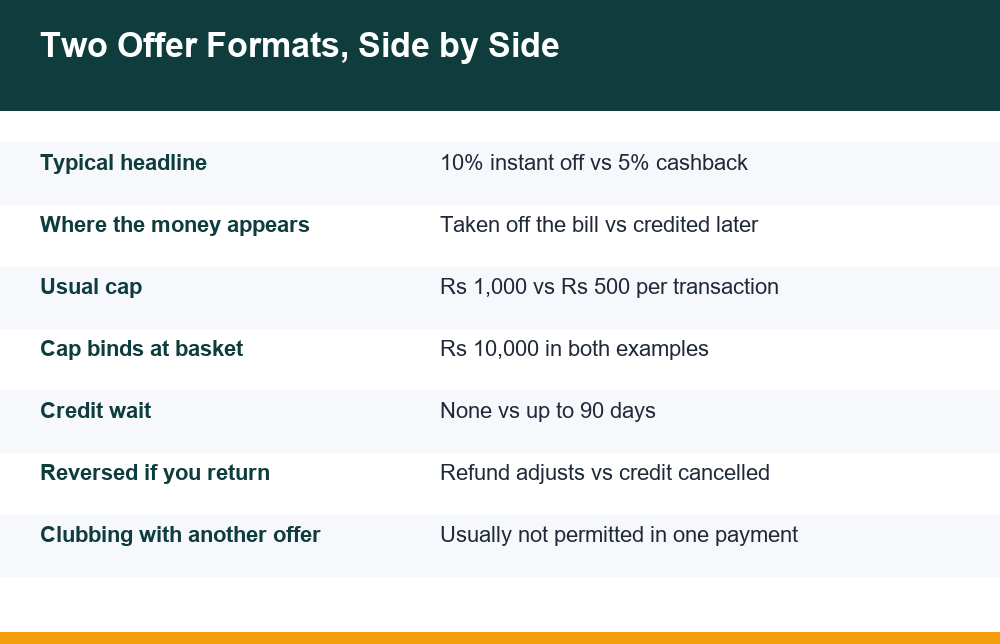
You are on a payment page with two banners competing for the same tap, and the whole question of instant discount vs cashback comes down to arithmetic nobody on that page has done for you. One banner offers 10% off immediately, capped at Rs 1,000. The other offers 5% back, capped at Rs 500, credited within 90 days. The percentages are not comparable, the caps are doing the real work, and almost every page that ranks for this comparison is published by a bank or a retailer that happens to sell the format it recommends.
We are not selling either one. Below is the same basket run both ways, the point at which the headline percentage stops mattering, and the three fine-print clauses that quietly decide the outcome: the cap, the clubbing rule, and the credit date.
Table of Contents
The Basket In Front Of You
Take a single basket of Rs 8,400 — an appliance, a cable, and a two-year protection plan. Nothing about that basket changes depending on which banner you tap. What changes is how much leaves your account today and how much, if any, comes back later.
With a 10% instant offer capped at Rs 1,000, the page recalculates before you pay: Rs 840 comes off and you are charged Rs 7,560. With a 5% cashback offer capped at Rs 500, you are charged the full Rs 8,400 and Rs 420 is scheduled to arrive on the card statement or wallet at some later date. Same basket, two different numbers on your account today, and two very different levels of certainty.
That certainty gap is the part the banners never price. An instant reduction is final the moment the transaction succeeds — it shows up as a lower authorised amount, and there is nothing left to process. A deferred credit depends on the merchant reporting the transaction correctly, the offer being in force on the transaction date, the transaction not being partially refunded, and the processing cycle completing. Each of those is usually fine. None of them is guaranteed by the banner.
It also matters which number your other decisions are built on. The instant format lowers the amount that hits your credit limit, the amount that carries interest if you revolve the balance, and the amount that any EMI conversion is calculated on. The deferred format leaves all three at the full basket value and settles up afterwards. On a small basket that difference is trivial. On a large one, paid off over several months, it is not.
So instant discount vs cashback is never just percentage against percentage. It is money off now, with a cap, against a smaller amount later, with a different cap and a list of conditions. Once you set it out that way the decision usually makes itself — but only after you check where your basket sits relative to the caps.
Where The Cap Decides Instant Discount Vs Cashback
The headline percentage only applies until the cap is reached. After that the saving freezes while your bill keeps growing, so the effective rate falls away. This is the single most important fact in instant discount vs cashback, and it is almost always printed in smaller type below the number that made you look.
A 10% offer capped at Rs 1,000 stops being a 10% offer at a basket of Rs 10,000. At Rs 20,000 it is a 5% offer. At Rs 50,000 it is a 2% offer. A 5% cashback capped at Rs 500 behaves the same way and also binds at Rs 10,000 — above that, it decays just as fast. Two offers with completely different headlines can start decaying at exactly the same basket value.
Here is the same pair run across a range of baskets, with the effective rate shown so the decay is visible rather than buried:
| Basket | 10% instant, cap Rs 1,000 | 5% cashback, cap Rs 500 | Effective rate (instant) | Effective rate (cashback) |
|---|---|---|---|---|
| Rs 3,000 | Rs 300 | Rs 150 | 10.0% | 5.0% |
| Rs 5,000 | Rs 500 | Rs 250 | 10.0% | 5.0% |
| Rs 8,400 | Rs 840 | Rs 420 | 10.0% | 5.0% |
| Rs 10,000 | Rs 1,000 | Rs 500 | 10.0% | 5.0% |
| Rs 15,000 | Rs 1,000 | Rs 500 | 6.7% | 3.3% |
| Rs 25,000 | Rs 1,000 | Rs 500 | 4.0% | 2.0% |
| Rs 60,000 | Rs 1,000 | Rs 500 | 1.7% | 0.8% |
Read the last row carefully. On a Rs 60,000 basket, a banner shouting 10% off is delivering 1.7%. The percentage was true; it was just true about a basket you are not buying. If you only remember one thing from this page, remember to divide the cap by your actual basket before you believe any headline.
There is a second cap most people never read for, because it is not written on the banner at all. Alongside the per-transaction cap, many offers carry a monthly or per-card limit — a total across the whole offer period, after which the same card stops qualifying even though the offer is still running. If you are making two or three purchases in the same window, the first one can consume the allowance and leave the later ones at full price with no visible explanation.
The practical consequence is that large baskets should be judged on rupees, not percentages, and small baskets are where percentages still mean something. On a Rs 2,000 basket the cap is irrelevant and the higher percentage simply wins. Above the cap threshold, the comparison becomes Rs 1,000 today versus Rs 500 in three months — and framed that way, there is nothing left to argue about.
The Crossover Point Your Basket Can Cross
The pair above never crosses over, because the instant offer has both the higher rate and the higher cap. Real checkouts are messier than that. The interesting case is when the lower percentage carries the much larger cap — and that combination is common, because a generous cap costs the issuer less when the rate is small.
Consider a 10% instant discount capped at Rs 750 against a 5% cashback capped at Rs 2,000. The instant offer freezes at a basket of Rs 7,500. The cashback keeps growing until Rs 40,000. Somewhere between those two points the smaller percentage overtakes the bigger one.
| Basket | 10% instant, cap Rs 750 | 5% cashback, cap Rs 2,000 | Larger figure |
|---|---|---|---|
| Rs 6,000 | Rs 600 | Rs 300 | Instant |
| Rs 7,500 | Rs 750 | Rs 375 | Instant |
| Rs 12,000 | Rs 750 | Rs 600 | Instant |
| Rs 15,000 | Rs 750 | Rs 750 | Level — the crossover |
| Rs 20,000 | Rs 750 | Rs 1,000 | Cashback |
| Rs 35,000 | Rs 750 | Rs 1,750 | Cashback |
The crossover sits at Rs 15,000, and you can find it yourself in one step: divide the instant cap by the cashback rate. Rs 750 divided by 0.05 gives Rs 15,000. Below that basket the instant offer is larger; above it the cashback is larger in rupees — though it still arrives later, which is a separate cost covered further down.
The same one-line sum works on any pair, provided your basket is already past the point where the instant cap binds. If it is not, the instant offer is still growing and the higher percentage is simply ahead. Two quick sanity checks keep you from using the formula on the wrong numbers: divide the instant cap by the instant rate to see where it freezes, and divide the cashback cap by the cashback rate to see where that one freezes. The crossover only exists in the window between those two points.
This is the whole mechanism behind instant discount vs cashback, and it is why a blanket answer is worthless. The right format is a function of your basket size, not of which format is fashionable. Two people at the same checkout on the same day, with baskets of Rs 6,000 and Rs 30,000, should correctly choose differently.
One caveat on the crossover: it tells you which number is bigger, not which is safer. Crossing the line by a few hundred rupees is not a good reason to accept a deferred credit with conditions attached. Treat a narrow win for cashback as a tie, and break the tie in favour of money that is already off the bill.
Can A Bank Offer And A Cashback Offer Be Combined?
Usually not within a single payment, and this is the assumption that costs people the most. Both banners sit on the same page, both look available, and neither says choose one in a size you can read. But offer terms are typically written to apply per transaction and to exclude other instrument-linked offers on the same transaction, so selecting one commonly disqualifies the other.
There are three distinct things people mean when they ask about stacking, and only one of them usually works:
- A store coupon plus a payment offer. This often does work, because the coupon reduces the price and the payment offer applies to what is left. The two are granted by different parties.
- Two payment-instrument offers on one transaction. This almost never works. An instant discount and a cashback offer tied to cards, UPI or a wallet are competing for the same payment leg, and the terms generally permit one.
- A platform reward layer on top of a bank offer. Sometimes allowed, sometimes voided by the bank offer’s own exclusions. Treat it as unverified until it actually appears, and never size your basket around it.
Splitting the bill across two payment methods is the next idea people try, and it rarely helps. Where part-payment is even allowed, the offer is normally assessed against the amount charged to the qualifying instrument, not the basket total — so half the basket means half the saving, and the minimum transaction value is often applied to that half as well. Two half-payments frequently qualify for nothing where one full payment would have qualified for something.
If you want to understand why the two formats are structurally mutually exclusive rather than merely restricted by policy, our breakdown of how cashback is funded and settled behind a transaction walks through where the money comes from in each case. Once you see that both are paid out of the same merchant-funded and interchange pool, the exclusion stops looking arbitrary.
The reliable test is not reading the terms. It is watching the total. Select one offer and note the payable amount. Deselect it, select the other, note the amount again. If selecting the second one did not reduce the figure further, they are not combining, whatever the page implies. Do this before entering any payment details, not after.
Why The Discount Was Not Shown At Checkout
An instant discount is not automatic. It is a selection you make on the payment page, and if you do not make it, the transaction completes at full price with no obvious recovery path. Retailer banners advertise the offer on the product page, where you cannot act on it, and then rely on you to find the checkbox three screens later.
The common reasons a valid offer fails to appear, in the order worth checking:
- The basket is below the minimum transaction value, which is often set just above the price of the item the banner was advertising.
- The payment method does not match. Offers are frequently restricted to a specific card network, a credit card but not the debit card, or EMI but not full payment.
- The item sits in an excluded category. Protection plans, gift cards, groceries and already-discounted lines are routinely carved out, which can also drag the basket below the minimum.
- The offer is exhausted for the day or the cycle, in which case the banner often stays up while the checkbox quietly disappears.
- The card was saved as a token and the page cannot read the issuer until the full number is re-entered.
- The offer window closed. Many run for specific dates or specific hours, and the product page is slower to update than the payment page.
- The offer is tied to a specific co-branded card or card variant rather than to the whole issuer. A banner naming a bank does not mean every card from that bank qualifies, and the page will usually just omit the checkbox rather than explain why.
Note that of the two formats in the instant discount vs cashback comparison, only the instant one can fail silently at this stage. A cashback offer tied to the card generally does not need selecting, which is one genuine point in its favour — it also means you have nothing on screen confirming it was applied.
If you have already paid and the discount never applied, the money is usually not recoverable afterwards, because the transaction was authorised at the amount you approved. The realistic options are the return window and a fresh, correct transaction. Our checklist on what to do when a bank offer fails to apply at the payment page sets out the sequence and the time limits that matter.
The preventive habit is simple and takes four seconds: before authorising, read the final payable figure and confirm it is lower than the cart total by roughly the amount you expect. Not the banner. Not the confirmation screen afterwards. The payable figure, before you authorise.
What A 90-Day Credit Actually Costs You
A deferred credit is worth less than the same rupees today, and the gap is larger than the arithmetic alone suggests. The time value is the small part. The real cost is the set of events that can occur between the purchase and the credit date.
On the time value: Rs 500 arriving in 90 days, against money that would otherwise sit in a savings balance, is worth a handful of rupees less than Rs 500 today. That is genuinely negligible and not worth factoring into a decision. Anyone presenting that discount rate as the reason to prefer instant is overstating it.
The conditions are not negligible. In a 90-day window the item can be returned or partially refunded, which usually cancels or reverses the credit. The transaction can be reported under a merchant category that the offer excludes. The card can be closed, replaced or upgraded to a different variant. The credit can land as reward points redeemable only inside a particular catalogue rather than as money. And you will almost certainly stop tracking it, which means a credit that never arrives is also a credit you never chase.
That last point deserves a practical answer rather than a shrug. If you accept a deferred offer, write down the transaction date, the amount you expect, the offer name as it appeared on the page, and the date by which the credit is promised. A screenshot of the payment page with the offer selected takes two seconds and is the only record you will have that the offer existed at all, since these pages are replaced constantly and the terms are rarely archived anywhere you can reach.
This is why instant discount vs cashback should be judged on expected value rather than face value. If you think there is a one-in-ten chance a Rs 500 credit does not materialise or arrives as restricted points, you are comparing roughly Rs 450 of usable value against Rs 840 that is already off the bill. The decision is not close.
Two situations genuinely favour the deferred format: baskets comfortably past the crossover point, and credits that post to the statement within one cycle rather than three. A credit that arrives on next month’s statement carries far fewer ways to go wrong than one scheduled for 90 days out. The credit date is worth more attention than the percentage.
If the item is one you can wait on, neither offer is the strongest move available. Buying the same basket at a genuinely lower base price beats optimising the offer layer on top of a price that was never the floor. Watching the base price for a while — the subject of our notes on tracking price movements before you commit to a purchase — regularly outperforms both banners.
Which Amount The Percentage Runs On
Percentages need a base, and the base is where the small print earns its keep. Both halves of instant discount vs cashback are normally calculated on the net payable amount after coupons and after any price reduction already applied — not on the list price, and not on the pre-coupon total.
Sequence it on a concrete basket. List price Rs 10,000, store coupon takes Rs 1,000 off, leaving Rs 9,000 payable. A 10% instant discount capped at Rs 1,000 now applies to Rs 9,000, giving Rs 900 and a final payable of Rs 8,100. It does not give Rs 1,000, because 10% of Rs 9,000 is Rs 900 and the cap was never reached. The coupon shrank the base, which shrank the discount.
Cashback behaves identically. 5% on that same Rs 9,000 net figure is Rs 450, not Rs 500, and not 5% of the Rs 10,000 list price. Any page quoting the saving off list price is quoting a number you will not receive.
This is also why the order of operations can decide whether you clear a threshold. A coupon that drops the payable figure below the offer’s minimum transaction value can remove the payment offer entirely, so the Rs 1,000 coupon costs you the Rs 900 discount and leaves you worse off than not using it. Checkouts almost never flag that trade-off, and the only way to see it is to apply the coupon, look at the offer list, and remove the coupon again if the offer disappeared.
Three base-amount details that are easy to miss:
- Delivery, installation and convenience fees are commonly excluded from the base even though they are included in what you pay.
- Taxes may or may not be in the base, and the terms are frequently silent, which in practice means you should plan on the lower figure.
- On a partial return, the saving is recalculated on the retained items — so a discount that was at its cap before the return often falls below it after.
None of this makes either format dishonest. It makes the advertised percentage an upper bound rather than a figure. Compute from the payable amount, not the price on the tag, and the two formats become directly comparable for the first time.
Seven Checks To Run Before You Pay
Seven items, under a minute in total, and they resolve the instant discount vs cashback question for whatever is actually in your basket right now rather than in the abstract:
- Find the cap. Divide it by your basket. That ratio, not the banner, is your real savings rate on this purchase.
- Locate the crossover. Instant cap divided by the cashback rate gives the basket value where the two are level. Note which side of it you are on.
- Check the minimum transaction value against your basket after exclusions, not before — excluded items can push you below it.
- Confirm the payment instrument matches exactly: network, credit or debit, card variant, full payment or EMI. Mismatch is the most common silent failure.
- Test for clubbing by watching the total, not by reading the terms. Select each offer in turn and compare payable figures.
- Read the credit date, not just the amount. Next statement cycle and ninety days are different products wearing the same label.
- Verify the payable figure before authorising. It must be lower than the cart total by close to the amount you expect, or the offer did not apply.
A reasonable default emerges from running these repeatedly. Below the crossover, take the instant reduction; it is larger and it is certain. Above the crossover by a wide margin, the deferred credit can be the better number, provided the credit lands within one statement cycle and posts as money rather than points. Near the crossover, take the instant reduction, because certainty is worth the small difference.
All seven are things you can read off the screen in front of you, in the ninety seconds before you authorise, on the basket you are actually buying — no banner, comparison page or outside source required.
Mistakes That Cost More Than The Offer Saves
Most money lost around instant discount vs cashback offers is not lost to the fine print. It is lost to a basket that grew to reach a minimum, or to treating an offer banner as evidence that the base price is good. Both mistakes are larger than anything in the terms and conditions.
The upsizing trap is the expensive one. Adding Rs 2,200 of items you did not want to unlock a Rs 1,000 cap leaves you Rs 1,200 worse off, and the page will congratulate you on the saving. If the basket had to grow to qualify, the offer did not save you anything — it sold you something.
The second trap is anchoring. A visible 10% banner makes the underlying price feel validated, and that price is set by the seller, who knows the banner is there. Compare the base price against the same item elsewhere before applying either offer. A base price Rs 1,500 lower with no offer at all beats a higher base price with a Rs 1,000 instant discount, every time.
A third, quieter one: converting to EMI because that was the variant the offer required. The discount is real, and so is the interest or the processing fee on the instalment plan, and the second figure is often the larger of the two. Work out the total cost of the instalment plan before you let an offer choose your payment method for you.
Also worth naming because it circulates widely: messages promising an extra cashback credit if you share a reference number, scan a code sent to you, or confirm card details to release a pending credit. Genuine credits from either format post automatically and require nothing from you. Any request for an action to unlock a credit is the mechanic to walk away from, and this is a warning rather than a nuance. If a seller will not honour an offer it advertised and its own support team gets you nowhere, the Department of Consumer Affairs runs the National Consumer Helpline portal as the official non-commercial place to register a consumer grievance.
Stripped to its core, the comparison is small. Work out what each offer pays on your actual basket, note which one you receive today, and prefer the certain figure unless the deferred one is clearly and comfortably larger. No offer format is a saving if the thing was not worth buying at the base price.
Frequently Asked Questions
Is instant discount better than cashback?
On most baskets, yes — but it depends on the caps, not the percentages. Instant discount vs cashback is decided by dividing the instant cap by the cashback rate: that gives the basket value where the two are level. Below it the instant reduction is larger and certain; well above it the cashback can pay more in rupees, though it still arrives later with conditions attached. Near the crossover, prefer the money that comes off the bill today.
Can I use a bank offer and a cashback offer together?
Usually not within the same payment. Both are instrument-linked offers competing for the same payment leg, and the terms typically permit one per transaction, so selecting one disqualifies the other. A store coupon plus one payment offer often does work, because they are granted by different parties. The reliable test is to select each offer in turn and compare the payable total — if the second selection did not reduce it further, they are not combining.
Why was my instant discount not shown at checkout?
Most often the basket fell below the minimum transaction value after excluded items were removed, or the payment method did not match the offer exactly — credit but not debit, one card network only, one card variant only, or EMI but not full payment. Other causes are an exhausted daily quota, a closed offer window, or a tokenised card the page cannot identify until the full number is re-entered. The offer is a selection you make on the payment page, so always confirm the payable figure before authorising.
How long does cashback take to be credited after a sale purchase?
Terms commonly state up to 90 days from the transaction date, and sale periods sit at the slower end of that range because of volume. Some offers post within the next statement cycle instead, which is a materially better product wearing the same label. Read the credit date rather than just the amount, and note that a return or partial refund inside the window usually cancels or reverses the credit.
Does instant discount apply before or after the coupon?
After. The coupon reduces the price first, and the discount percentage is then calculated on the net payable amount. So a Rs 10,000 basket with a Rs 1,000 coupon leaves Rs 9,000, and a 10% instant discount on that gives Rs 900, not Rs 1,000 — the coupon shrank the base. Watch the minimum transaction value too: a coupon that drops the payable figure below it can remove the payment offer altogether.
Is cashback counted on the discounted amount or the full price?
On the discounted amount — the net payable figure after coupons and any price reduction already applied, not on the list price. A 5% cashback on a basket that drops from Rs 10,000 to Rs 9,000 pays Rs 450, not Rs 500. Any page quoting the saving against list price is quoting a number you will not receive, so always compute from the payable total.
{"@context": "https://schema.org", "@type": "FAQPage", "mainEntity": [{"@type": "Question", "name": "Is instant discount better than cashback?", "acceptedAnswer": {"@type": "Answer", "text": "On most baskets, yes — but it depends on the caps, not the percentages. Instant discount vs cashback is decided by dividing the instant cap by the cashback rate: that gives the basket value where the two are level. Below it the instant reduction is larger and certain; well above it the cashback can pay more in rupees, though it still arrives later with conditions attached. Near the crossover, prefer the money that comes off the bill today."}}, {"@type": "Question", "name": "Can I use a bank offer and a cashback offer together?", "acceptedAnswer": {"@type": "Answer", "text": "Usually not within the same payment. Both are instrument-linked offers competing for the same payment leg, and the terms typically permit one per transaction, so selecting one disqualifies the other. A store coupon plus one payment offer often does work, because they are granted by different parties. The reliable test is to select each offer in turn and compare the payable total — if the second selection did not reduce it further, they are not combining."}}, {"@type": "Question", "name": "Why was my instant discount not shown at checkout?", "acceptedAnswer": {"@type": "Answer", "text": "Most often the basket fell below the minimum transaction value after excluded items were removed, or the payment method did not match the offer exactly — credit but not debit, one card network only, one card variant only, or EMI but not full payment. Other causes are an exhausted daily quota, a closed offer window, or a tokenised card the page cannot identify until the full number is re-entered. The offer is a selection you make on the payment page, so always confirm the payable figure before authorising."}}, {"@type": "Question", "name": "How long does cashback take to be credited after a sale purchase?", "acceptedAnswer": {"@type": "Answer", "text": "Terms commonly state up to 90 days from the transaction date, and sale periods sit at the slower end of that range because of volume. Some offers post within the next statement cycle instead, which is a materially better product wearing the same label. Read the credit date rather than just the amount, and note that a return or partial refund inside the window usually cancels or reverses the credit."}}, {"@type": "Question", "name": "Does instant discount apply before or after the coupon?", "acceptedAnswer": {"@type": "Answer", "text": "After. The coupon reduces the price first, and the discount percentage is then calculated on the net payable amount. So a Rs 10,000 basket with a Rs 1,000 coupon leaves Rs 9,000, and a 10% instant discount on that gives Rs 900, not Rs 1,000 — the coupon shrank the base. Watch the minimum transaction value too: a coupon that drops the payable figure below it can remove the payment offer altogether."}}, {"@type": "Question", "name": "Is cashback counted on the discounted amount or the full price?", "acceptedAnswer": {"@type": "Answer", "text": "On the discounted amount — the net payable figure after coupons and any price reduction already applied, not on the list price. A 5% cashback on a basket that drops from Rs 10,000 to Rs 9,000 pays Rs 450, not Rs 500. Any page quoting the saving against list price is quoting a number you will not receive, so always compute from the payable total."}}]}