Are Reward Apps Worth It? 9 Honest Numbers Before You Install
Are reward apps worth it once you count payout thresholds, disqualified tasks, data use and permissions? An honest ledger with both sides of the arithmetic.
 Madhammer
October 22, 2026 · 20 min read
You installed one because a short video said it pays daily, and three weeks later the balance still sits below the minimum withdrawal — so are reward apps worth it, or is the install itself the product being sold? That second reading is closer to the truth than most search results will admit. Almost every page on the first screen for this question is paid per download, which is why they all publish an earnings column and none of them publishes a cost column. This breakdown does both.
It sets out what an app pays per action, the threshold you have to cross before any of it is yours, how often an attempt is disqualified before it credits, and the costs that never appear in a screenshot: mobile data, attention, notification load, and the permissions and payment identifiers you hand over at setup. Then it does the one piece of arithmetic that settles the matter — return per hour of real effort rather than per month of vague activity. Honesty line up front: nothing here is a way to make money, and for most readers the conclusion is that the same hours are worth more somewhere else.
Table of Contents
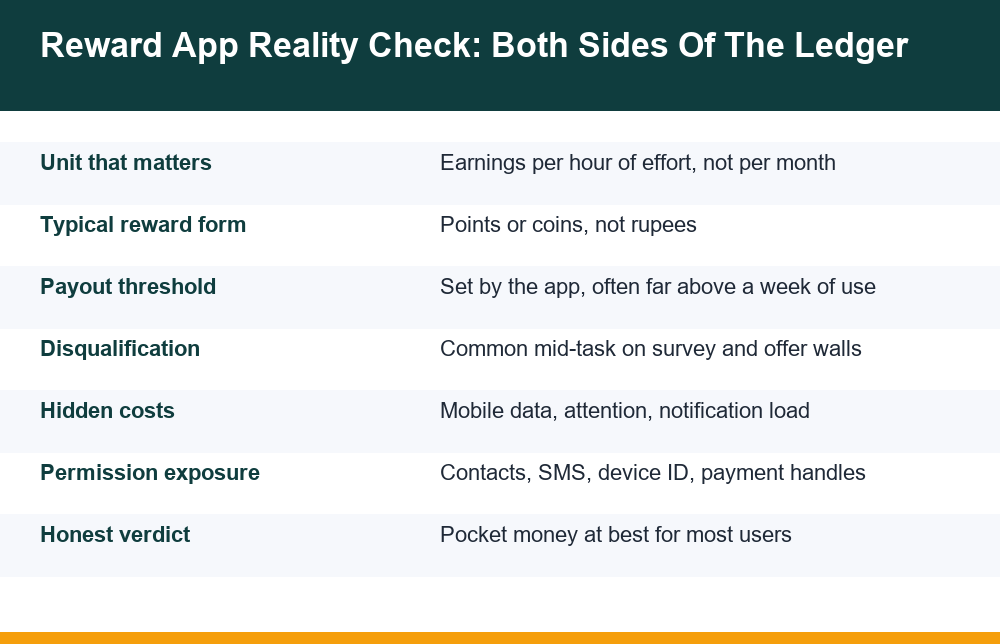
Are reward apps worth it? Start by building the missing cost side
A review is only useful if the reviewer can lose something by being wrong. The pages competing for this query cannot: they are compensated on the install, so a reader who downloads the app, earns nothing and uninstalls it a month later has already produced the full value of that page. Nothing in that arrangement rewards describing a threshold you will not reach, or a task type that disqualifies most attempts. The result is a search results page full of monthly income ranges presented as typical, with no mention of the hours behind them or how many users got nothing at all.
Treat an income range with no time denominator as missing information rather than good news. Rupees per month is not a rate. It conceals whether the figure came from ten minutes a day or four hours a day, whether it includes referral income from a network the reader does not have, and whether it was ever withdrawn or just displayed on a dashboard. A rate needs two numbers. Most pages publish one.
The honest version is a two-column ledger. On the left: what credits, how reliably, and in what unit. On the right: what it costs you to make that credit happen. Nothing in the second column is exotic — it is time, data, attention and access — but because none of it is denominated in rupees, it is easy to leave out, and leaving it out is exactly what makes a weak offer look strong.
- Earnings column: value per completed action, conversion rate from points to money, reliability of crediting, and the minimum before withdrawal.
- Cost column: minutes per action including failed attempts, mobile data consumed, notifications accepted, permissions granted, and identifiers shared.
- The only output that matters: the first column divided by the hours in the second, after subtracting everything that never credited.
Build that and the question stops being a matter of opinion. It becomes a number you can compare against anything else you could do with the same hour. It also becomes portable: the same two columns work for a cashback app, a survey panel, a lock-screen rewards tool or an offer wall, because every one of them is funded the same way and constrained by the same ceiling.
What the app actually pays per action
The first thing to notice is the unit. Reward apps almost never pay in rupees. They pay in coins, points, stars, scratch cards or spins, and the exchange rate between that unit and real money is set by the app, changeable by the app, and frequently not displayed until you are deep into the balance screen. A screen reading 4,500 coins is designed to feel like progress. Whether it is worth four rupees or forty is a separate fact you have to go and find.
The second thing is that the payout per action is set by what the app earns from you, not by what your time is worth. Watching a video advertisement pays a fraction of the advertiser’s bid. Installing and opening a third-party app pays a slice of a bounty. Completing a survey pays a slice of a research panel fee, and only when your demographic profile is one the panel is short of. None of these are negotiable, and all of them tend to fall as an app scales, because the app’s own margin comes first.
A worked example rather than a claimed statistic, since the exact rates differ by app and change constantly. Suppose an app credits 5 coins for a 30-second video, allows 20 videos a day, and converts 1,000 coins to 10 rupees. That is 100 coins a day, one rupee a day, roughly ten minutes of watching plus load time. Thirty rupees a month for about five hours. Run that arithmetic with the real numbers from whatever app is in front of you, because the structure is what repeats even when the rates do not.
| Action type | What it pays from | Why the rate is low | Main failure mode |
|---|---|---|---|
| Watch an ad or video | A share of the advertiser’s impression bid | Impressions are cheap and capped per user per day | Daily cap hit within minutes |
| Install and open an app | A slice of a user-acquisition bounty | Bounty only pays if you keep the app installed | Credit reversed when you uninstall |
| Complete a survey | A slice of a research panel fee | Panels pay per qualified respondent, not per attempt | Screened out partway through, no credit |
| Offer wall task | A conditional affiliate payout | Payout requires a deep in-app milestone | Milestone not reached, task expires |
| Scratch card or spin | Nothing fixed at all | Value is randomised and mostly near zero | Expires unused, or converts to a coupon |
| Refer a friend | The app’s acquisition budget | Budget is finite and promotional | Terms change, tier resets, referral never qualifies |
Notice how many of the failure modes are structural rather than accidental. An offer wall task that requires reaching level twenty of a game is not broken when you stop at level six — it is working exactly as designed, because the advertiser only pays for users who got that far. The same logic governs purchase-linked rewards, and it is worth understanding how a cashback credit is actually funded and tracked before assuming any pending amount is money you already have.
There is a third feature of the unit worth stating plainly: the app controls both sides of the exchange. It decides how many coins an action earns and how many coins a rupee costs, and it can move either without touching the number on your screen. A balance that looked like two hundred rupees last month can be worth half that this month with no visible deduction at all. Any balance held in a private unit is a claim on the app’s current policy, not a stored amount, and that is the single most important difference between a reward balance and money.
The payout threshold is the part nobody shows you
Every reward app sets a minimum balance before you can withdraw anything. That threshold is the single most important number in the entire proposition, and it is the number least likely to appear in a review, because it is where the honest answer lives. If an app pays roughly a rupee a day and the minimum withdrawal is two hundred rupees, the app has quietly told you it expects most users to quit before collecting.
Thresholds also move. A minimum can be raised, a withdrawal method can be removed, a balance can be split into a withdrawable portion and a promotional portion that only buys in-app items. Because the balance is denominated in the app’s own unit, none of this requires any visible change to your number — the coins stay, their meaning shifts. Read the withdrawal screen before the earning screen, every time.
- Find the minimum withdrawal figure, in rupees, not in coins.
- Find the conversion rate from the app’s unit to rupees, and whether the app reserves the right to change it.
- Check whether the whole balance is withdrawable or only a declared portion of it.
- Check the daily earning cap, then divide the threshold by it to get the number of days of perfect participation required.
- Check whether balances expire on inactivity, and after how many days.
- Check what happens on withdrawal: a transfer, a voucher, a coupon, or credit usable only inside the app.
Step four is the one that ends most discussions. Divide the threshold by the daily cap and you get the number of consecutive days of maximum effort you must put in before a single rupee becomes yours. If that number is comfortably longer than you realistically intend to keep the app, the app is not an earning opportunity for you. It is an advertising placement you are paying for with attention.
Then add the disqualification rate on top. Surveys and offer walls do not credit every attempt — screen-outs partway through a questionnaire and unmet in-app milestones are routine, and the time spent on an attempt that fails is spent either way. Any estimate built on completed tasks alone is an estimate of a day that does not happen. Build the estimate on attempts instead of completions and the days-to-threshold figure typically grows by a wide margin.
The form of the payout matters as much as the size of it. A transfer to a payment handle is money. A voucher for one specific merchant is money only if you were going to spend there anyway, at a price you had already accepted. In-app credit is not money at all — it is a discount on further participation. Anyone answering whether are reward apps worth it on the strength of a dashboard total is counting three different things as one, and the smallest of the three is usually the only one that is genuinely withdrawable.
Costs nobody counts: data, attention and permissions
Video rewards are paid in coins and funded by streaming video to your phone. That is mobile data, and on a metered plan it is a real cost denominated in the same rupees the reward is eventually converted into. Nobody is suggesting this bankrupts anyone, but a model where the reward per video is a fraction of a rupee and the video itself consumes measurable data deserves to have both numbers written down rather than only one.
The arithmetic is easy to run yourself and worth running once. Most phones report per-app data use in settings, so note the figure after a week of normal use and set it beside the rupees that actually credited in the same week. On an unmetered connection the cost may be negligible. On a small monthly pack consumed largely by reward videos, the ratio can get uncomfortable, and it is a cost no screenshot of a balance will ever show you. Battery and storage belong in the same column: apps built around background polling and frequent notifications are not free to run, even if the amounts are small.
Attention is the larger cost and the harder one to price. These apps are built around daily streaks, expiring bonuses, countdown timers and notification pressure, because engagement is the product being sold upstream. The design goal is for you to open the app when it pings, not when you decided to. Several notifications a day, each pulling you out of whatever you were doing, is a cost that shows up in your week even though it never shows up in your balance.
Then there is access. Setup commonly asks for far more than the task requires, and each request deserves a separate decision rather than a reflexive allow. The relevant question is never whether a permission is normal — it is what the task in front of you actually needs.
- Contacts: requested for referral features. A referral link in a message app needs no address book access.
- SMS access: sometimes framed as reading a confirmation code. This exposes every other message on the device, including financial ones.
- Device and advertising identifiers: the basis of the profile that makes your attention saleable.
- Payment identifiers: a payment handle or account detail used to send a payout. Supplying one to receive money is ordinary; supplying one before anything has been earned is not.
- Accessibility or overlay permissions: requested by some task-automation offers. These grant very broad control over what happens on screen.
- Location: often requested for “relevant offers”. Continuous background location is a large concession for a marginal change in which advertisement you see.
A reasonable rule: grant nothing before the app has actually paid you something, grant the narrowest version of anything you do grant, and never provide a credential, PIN or one-time code to an app or a person in exchange for a promised reward. A payout needs an account handle. It never needs a password or a code. This column is why the answer to whether are reward apps worth it so rarely turns on the earnings figure at all. On most phones permissions can be reviewed and withdrawn after the fact, which makes an occasional audit of what is still granted a cheap habit.
Earnings per hour of effort, not per month
Here is the calculation that replaces every income range you have been shown. Take the total you actually withdrew — not pending, not displayed, withdrawn — over a fixed stretch of weeks. Then estimate the time honestly: time on completed tasks, plus time on attempts that failed, plus the minutes spent opening the app because it pinged, plus the time spent reading terms and chasing credits that did not arrive. Divide. The result is your real rate, and it is almost always a fraction of what the first estimate suggested, because the first estimate counted only the minutes that worked.
Two things usually become obvious at that point. The first is that the rate is low in absolute terms. The second is that it degrades with use: the easiest and best-paying actions are front-loaded to get you past the early sessions, the daily caps bite quickly, and the remaining task types are the slow, frequently disqualified ones. A first week is not a sample of a normal week. Survey-based earning shows this pattern especially clearly, and it is worth comparing against what survey apps return per hour once screen-outs are counted rather than per completed response.
Are reward apps worth it at the rate you actually measured?
Comparison is the honest final step. Set your computed rate beside anything else the same hour could buy — rest, study, a skill that compounds, unpaid-but-useful household work, or simply not being interrupted. That comparison is personal, and for some readers in some weeks a few rupees for time that was going to be spent scrolling anyway is a fair trade. What it is not, for essentially anyone, is income. The structure does not permit it. The payout per action is set by advertising economics, the caps are deliberate, and the threshold exists to filter out the majority who will never collect.
So the answer to whether are reward apps worth it is conditional, and the condition is specific: worth it only if your computed per-hour rate is acceptable to you after failed attempts, and only if the permissions and notification load are acceptable independently. If either side fails, no amount of streak bonus fixes it.
Three patterns that mean the money will never arrive
Separate from the ordinary low-return app is a category where the arithmetic is not merely poor but impossible. These are worth naming precisely, because the warning signs are structural and visible before you install anything. This section explains the mechanics in order to warn, not to point anyone toward them.
Pattern one: large daily payouts for watching advertisements
An app promising a meaningful daily sum for a few minutes of ad watching is claiming to pay you more than the advertising inventory is worth. There is no margin in which that works. Where such a promise is kept at all, it is kept briefly, with money from newer users, and it stops. The tell is simple: compare the promised payout against what an impression plausibly earns. If the promise is many multiples of it, the shortfall is being funded by something other than advertising.
Pattern two: earnings that depend on recruiting more users
If the headline income comes from a tiered referral structure — your recruits, their recruits, bonuses for reaching a level of a downline — then the money entering the system is coming from participants rather than from any external buyer. Structures of that shape pay early joiners from later joiners and stall when recruitment slows, which it always does. Treat a joining fee, a deposit, or a mandatory purchase to unlock earning as decisive. Ordinary reward mechanisms do not require you to pay in to begin.
Pattern three: no underlying product at all
Ask what business the app is in. A cashback mechanism exists because merchants pay for sales. A survey panel exists because researchers pay for responses. An ad network exists because advertisers pay for attention. If you cannot identify who outside the app is paying and what for, there is no revenue to share, and whatever is arriving in your balance is coming from somewhere that will not last. A related tell in this category: apps marketed as earning tools that turn out, after install, to be real-money prediction or wagering products with an earning label on the storefront.
- Decisive red flags: a fee or deposit to unlock earning, a tiered downline, guaranteed returns, or pressure to recruit before you have been paid.
- Strong warnings: no identifiable company behind the app, withdrawal terms that change, support reachable only through a chat group, payouts conditional on recruiting.
- Worth pausing over: a threshold far beyond plausible earning, balances that expire, permissions unrelated to any visible task.
All three patterns share one diagnostic, which is why the checklist at the end starts with it: name the outside payer. Where an app can point to advertisers, merchants or research buyers, the return may be small but the mechanism is real. Where it cannot, the balance on screen is a number the app typed, and asking whether are reward apps worth it in that case is the wrong question — nothing is being earned at all.
Why a balance disappears and why referral income fades
A vanishing balance is rarely a glitch. The common causes are all written into the terms you accepted, and knowing which one applies tells you whether anything can be recovered. Reversal is the most frequent: a credit was provisional, the upstream advertiser did not confirm the action, and the provisional amount was withdrawn. Uninstalling a bounty app too early, failing an offer wall milestone, or a cancelled purchase behind a cashback credit all produce this.
Expiry is the second cause. Many apps void points after a defined period of inactivity, and the clock is often shorter than users assume. The third is a terms change that reclassifies part of a balance as promotional and usable only inside the app. The fourth is an account flag — multiple accounts on one device, use of automation tools, or activity the app’s systems read as inconsistent — which can freeze a balance entirely. The fifth, less often considered, is that the balance was never a balance: a displayed pending total on a dashboard is a claim, not a holding.
Documentation is the only thing that helps. Screenshot the balance, the task, the timestamp and the terms as they stood, and raise the matter through the app’s own support channel first with those references attached. The process is much the same as pursuing any missing purchase-linked credit, and the same evidence discipline applies — see the walkthrough on what to do when a promised cashback amount never shows up. Where an app will not engage at all, consumers in India can record a complaint against a company on the government’s National Consumer Helpline portal, which issues a reference number and forwards the complaint to the business concerned.
Referral income fades for a different and more predictable reason. It is funded from an acquisition budget, which is promotional and finite by definition. The generous early tier exists to buy growth; once growth is bought, the terms tighten, qualification conditions appear, tiers reset, and the per-referral amount falls. Anyone whose reported monthly figure rests mostly on referrals is describing a window that has usually closed by the time the screenshot circulates.
There is a second cost to referral earning that rarely gets counted. Passing an app to friends and family spends something that is not replaceable with a bonus, and the person you brought in inherits every threshold, cap and permission request described above. If the honest answer on whether are reward apps worth it is “pocket money at best”, that is also the honest thing to say when forwarding a link, and a referral tier is a poor reason to say anything else.
A checklist to run before you install anything
None of the above requires trusting a review, including this one. It is all checkable in a few minutes on the app’s own screens, and running the checks before installing costs nothing. Work through them in order and stop at the first decisive failure.
- Identify the payer. Who outside the app provides the money, and for what? If the answer is other users, stop.
- Read the withdrawal screen first. Minimum payout in rupees, conversion rate, and whether the whole balance is withdrawable.
- Divide threshold by daily cap. That is the days of perfect effort before your first rupee. Decide if that is realistic for you.
- Assume a failure rate. Recompute on the assumption that a meaningful share of surveys and offers will not credit.
- Count the real minutes, including failed attempts and app-opens triggered by notifications.
- Audit the permission list against what the tasks visibly need. Contacts, SMS and overlay access rarely qualify.
- Confirm no money leaves you. No fee, no deposit, no mandatory purchase, no credential, no PIN, no one-time code — ever.
- Check the exit. How to delete the account and what happens to data and balance when you do.
- Compute the per-hour figure and compare it to anything else that hour could be used for.
Run that and the realistic outcome is clear. For the large majority of readers the honest conclusion on whether are reward apps worth it is that a well-structured app from an identifiable company produces pocket money, slowly, in exchange for attention and some data — and that the three patterns above produce nothing at all, however the dashboard looks in week one. If you install one anyway, do it with a figure in mind rather than a hope, grant the minimum, and judge it on what reached your account, not on what the balance screen displayed.
One closing note on the surrounding genre. Some products marketed as earning apps are real-money play, where losses are the mathematically expected outcome and no system changes that. Those are for adults only, and they belong in an entirely different conversation from a few coins for a survey.
Frequently Asked Questions
How much can you realistically earn from reward apps?
Far less than the monthly ranges in affiliate listicles, which omit the hours behind them. Payouts are set by advertising and panel economics and capped daily, so the realistic return is pocket money measured per hour of actual effort — including failed attempts and app-opens triggered by notifications. Compute your own rate from amounts you actually withdrew, not from a dashboard total.
Do reward apps actually pay out?
Established apps from identifiable companies generally do pay, but only after you cross a minimum withdrawal threshold, and many users quit before reaching it. Credits are often provisional and can be reversed if the upstream advertiser does not confirm the action. Apps promising large daily sums for watching ads, or paying mainly from recruitment, commonly do not pay at all.
What is the minimum payout on most reward apps?
There is no standard figure — each app sets its own, it is often expressed in coins rather than rupees, and it can be raised later. The useful test is arithmetic rather than the number itself: divide the threshold by the daily earning cap to see how many consecutive days of maximum effort are needed before any money becomes withdrawable.
Are reward apps safe to link to a bank account?
Providing a payment handle to receive a payout you have already earned is ordinary. Providing bank details, a PIN, a password or a one-time code before anything has been earned is not, and no genuine payout ever requires them. Grant nothing until the app has actually paid you, and refuse SMS, contacts and overlay permissions that the visible tasks do not need.
Why did my reward app balance disappear?
Usually a provisional credit was reversed because the advertiser did not confirm the action, or the points expired after inactivity, or a terms change reclassified part of the balance as in-app only, or the account was flagged. Screenshot the balance, task, timestamp and the terms as they stood, and raise it through the app’s own support channel with those references attached.
Do referral earnings on reward apps keep paying?
Rarely for long. Referral rewards come from a finite acquisition budget, so generous early tiers tighten once growth is bought: qualification conditions appear, tiers reset and per-referral amounts fall. Any reported monthly income resting mainly on referrals describes a window that has usually already closed. A tiered downline funded by participants is a structure to avoid entirely.
So are reward apps worth it for most people?
Only on a narrow condition: that the per-hour rate you compute yourself, after failed attempts, is acceptable, and that the permissions and notification load are acceptable on their own terms. For most readers the result is pocket money for time that could be worth more elsewhere, which is a fair trade in some weeks and not income in any week.
{"@context": "https://schema.org", "@type": "FAQPage", "mainEntity": [{"@type": "Question", "name": "How much can you realistically earn from reward apps?", "acceptedAnswer": {"@type": "Answer", "text": "Far less than the monthly ranges in affiliate listicles, which omit the hours behind them. Payouts are set by advertising and panel economics and capped daily, so the realistic return is pocket money measured per hour of actual effort — including failed attempts and app-opens triggered by notifications. Compute your own rate from amounts you actually withdrew, not from a dashboard total."}}, {"@type": "Question", "name": "Do reward apps actually pay out?", "acceptedAnswer": {"@type": "Answer", "text": "Established apps from identifiable companies generally do pay, but only after you cross a minimum withdrawal threshold, and many users quit before reaching it. Credits are often provisional and can be reversed if the upstream advertiser does not confirm the action. Apps promising large daily sums for watching ads, or paying mainly from recruitment, commonly do not pay at all."}}, {"@type": "Question", "name": "What is the minimum payout on most reward apps?", "acceptedAnswer": {"@type": "Answer", "text": "There is no standard figure — each app sets its own, it is often expressed in coins rather than rupees, and it can be raised later. The useful test is arithmetic rather than the number itself: divide the threshold by the daily earning cap to see how many consecutive days of maximum effort are needed before any money becomes withdrawable."}}, {"@type": "Question", "name": "Are reward apps safe to link to a bank account?", "acceptedAnswer": {"@type": "Answer", "text": "Providing a payment handle to receive a payout you have already earned is ordinary. Providing bank details, a PIN, a password or a one-time code before anything has been earned is not, and no genuine payout ever requires them. Grant nothing until the app has actually paid you, and refuse SMS, contacts and overlay permissions that the visible tasks do not need."}}, {"@type": "Question", "name": "Why did my reward app balance disappear?", "acceptedAnswer": {"@type": "Answer", "text": "Usually a provisional credit was reversed because the advertiser did not confirm the action, or the points expired after inactivity, or a terms change reclassified part of the balance as in-app only, or the account was flagged. Screenshot the balance, task, timestamp and the terms as they stood, and raise it through the app's own support channel with those references attached."}}, {"@type": "Question", "name": "Do referral earnings on reward apps keep paying?", "acceptedAnswer": {"@type": "Answer", "text": "Rarely for long. Referral rewards come from a finite acquisition budget, so generous early tiers tighten once growth is bought: qualification conditions appear, tiers reset and per-referral amounts fall. Any reported monthly income resting mainly on referrals describes a window that has usually already closed. A tiered downline funded by participants is a structure to avoid entirely."}}, {"@type": "Question", "name": "So are reward apps worth it for most people?", "acceptedAnswer": {"@type": "Answer", "text": "Only on a narrow condition: that the per-hour rate you compute yourself, after failed attempts, is acceptable, and that the permissions and notification load are acceptable on their own terms. For most readers the result is pocket money for time that could be worth more elsewhere, which is a fair trade in some weeks and not income in any week."}}]}