Survey App Earnings Per Hour: 7 Important Numbers Nobody Shows You
Survey app earnings per hour is the only figure that matters, yet panels quote monthly ranges. Here is the method to measure your own real rate.
 Madhammer
October 25, 2026 · 18 min read
The single thing almost every page about survey app earnings per hour gets wrong is that it never reports an hourly rate at all. It reports a monthly range — a few hundred rupees a month for about half an hour a day — and leaves you to assume the arithmetic behind it works. It usually does not, because a monthly range quietly counts only the sessions that ended in a credited reward.
The attempts that threw you out after three minutes of questions, the profile forms you filled before any survey appeared, the minutes spent refreshing a near-empty survey list: none of that time is in the denominator. This breakdown supplies the denominator. It gives you a method you can run on your own account in a week, a worked example showing what happens to a reward of Rs 60 for a stated twelve minutes once a realistic disqualification rate is applied, and an honest conclusion about the rate most people will find.
Table of Contents
Survey App Earnings Per Hour: The Number Pages Hide
A monthly figure is unfalsifiable. If someone tells you a panel pays Rs 800 a month, you cannot check it, because you do not know how many hours went in, how many attempts failed, or whether the balance was ever redeemed. An hourly figure is the opposite: it is a single number, it is comparable across panels, and it either clears the bar you set for your own time or it does not.
Search results on this topic are full of estimate-shaped writing with no method behind it. Panels themselves publish their payout minimums and their reward tables, which are real numbers, but they do not publish disqualification rates — and the disqualification rate is the input that moves the answer most. Reviews complain about high minimums without converting the complaint into arithmetic. The result is a topic where everyone is searching for a rate and nobody is answering with a rate.
There is a structural reason the monthly range survives. It is the only framing that flatters every party at once: it sounds like pocket money rather than work, it never has to specify how many attempts produced it, and it cannot be falsified by a reader who tries it for a week. An hourly figure can be falsified in seven days by anyone with a stopwatch, which is precisely why it is rarely offered.
There is also a definitional trap. The figure that matters is not reward divided by stated survey length. It is credited money divided by all the time you spent trying. Those two numbers can differ by a factor of three or more, and the gap between them is where the honest version of survey app earnings per hour lives.
Nothing here is a promise of income, and nothing here tells you to sign up anywhere. The point is to hand you a measuring instrument so you can decide for yourself, the same way you would check whether a cashback offer survives its own terms.
The 7 Numbers That Decide Your Real Rate
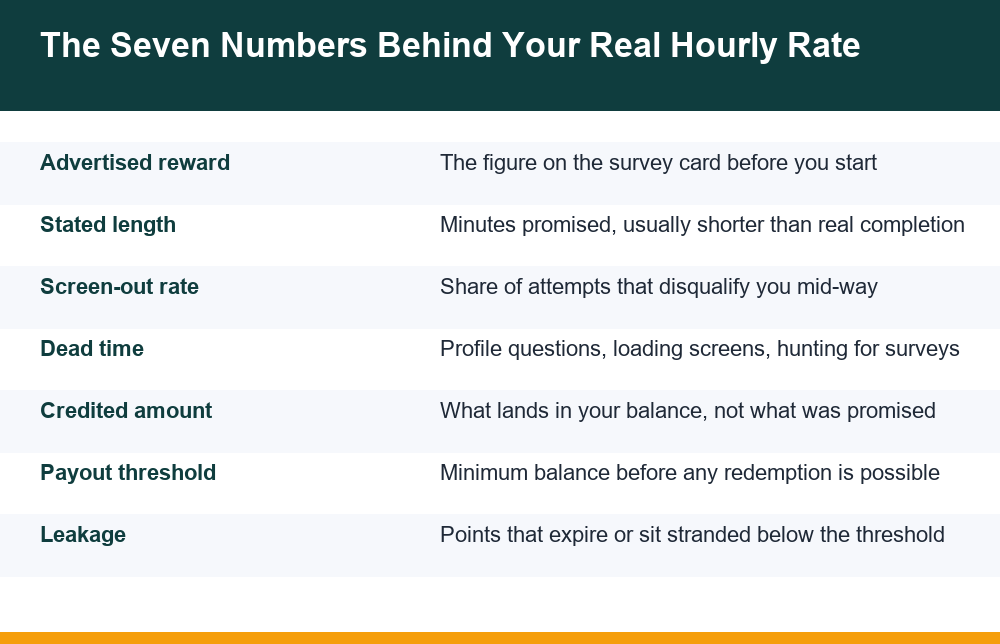
Every realistic estimate of survey app earnings per hour reduces to seven inputs. Six of them you can read off your own screen. The seventh — leakage — only becomes visible after a month or two, which is exactly why it is the one most often left out.
| # | Number | Where you find it | Why it moves the answer |
|---|---|---|---|
| 1 | Advertised reward | The survey card or offer wall | It is the ceiling, never the outcome |
| 2 | Stated length | Shown beside the reward | Real completion time commonly overruns it |
| 3 | Screen-out rate | Your own attempt log | The dominant variable; nothing else comes close |
| 4 | Dead time per attempt | Stopwatch | Profile questions and loading add up invisibly |
| 5 | Credited amount | Your balance history | Partial or pending credits are not the same as the advertised figure |
| 6 | Payout threshold | Redemption or rewards screen | Below it, your balance is unusable |
| 7 | Leakage | Expiry dates and dormant balances | Points that lapse were never earnings |
Notice that four of the seven work against you and none work in your favour. That asymmetry is structural, not a sign of a bad panel. A panel pays for completed, qualified responses, so the cost of your unqualified attempts sits with you. That is the trade you are accepting when you open the app.
Why the screen-out rate dominates
If you complete every survey you start, the advertised rate is roughly the real rate. If you are thrown out of two-thirds of them, your time per rupee roughly triples, because the failed attempts still cost three to five minutes each. No other input has that kind of leverage. This is why a page that quotes rewards but not disqualification rates has told you almost nothing.
The arithmetic is worth stating plainly. Suppose each completed survey is worth a fixed reward and takes a fixed time. Doubling the screen-out rate does not halve your rate, it does something slightly worse: it removes a paid attempt and replaces it with an unpaid one that still consumes minutes. Each failed attempt is therefore charged twice — once as income you did not receive, once as time you did spend. Nothing else in the list has that double effect, which is why your log needs a line for every attempt rather than a total for the week.
How To Measure Your Own Rate, Step By Step
Run this for one week on a single panel. One week is enough to get a usable number and short enough that you will actually finish it. Use a stopwatch and a plain notes file; do not estimate from memory, because memory systematically forgets the failed attempts.
- Start the clock when you open the app, not when a survey loads. Hunting for an available survey is working time.
- Log every attempt on its own line: date, advertised reward, stated length, and the outcome — completed, screened out, or technical failure.
- Record minutes for every attempt, including the ones that disqualified you after three questions. These are the lines that competitors’ estimates silently discard.
- Count profile and onboarding time once, as a separate entry. Amortise it across the week rather than ignoring it.
- Write down what was actually credited, checked against your balance a day later. Advertised and credited are different fields.
- Add up credited value and total minutes for the week. Divide credited value by minutes, then multiply by 60.
- Apply the threshold test: if your balance is still below the minimum payout, your realised rate for the week is zero until it clears.
That last step is the one people resist, and it is the honest one. Money you cannot withdraw is a claim, not income. Treating it as income is the same error as counting a cashback credit before the confirmation window closes — a distinction worth understanding if you want to know how cashback is actually credited and when it can be clawed back.
A worked example you can re-run with your own figures
Take a survey card advertising Rs 60 for a stated 12 minutes. On its face that is Rs 300 an hour, which would be a remarkable return for phone work. Now substitute observed behaviour. Assume 20 attempts over the week. Assume 13 of them screen you out at an average of 4 minutes each, which is 52 minutes. Assume the 7 that complete take 20 minutes each rather than 12, once profile questions and the usual overrun are counted, which is 140 minutes. Add one minute per attempt spent finding and loading the survey: 20 minutes. Total time is 212 minutes, or roughly 3.5 hours. Credited value is 7 multiplied by Rs 60, or Rs 420.
Rs 420 across 212 minutes works out near Rs 119 an hour — already well under half the advertised rate, before the threshold enters the picture. If roughly two-fifths of the balance then expires or sits stranded below the minimum payout, the realised figure lands nearer Rs 70. These are illustrative assumptions, not measurements; the whole point is that you replace every one of them with your own logged numbers. But the shape of the result holds, and it is the shape that explains why survey app earnings per hour almost never resembles the number on the card.
Two sensitivities are worth testing on your own figures before you trust the result. Change the screen-out count from 13 to 6 and the same week produces far more credited value for barely more time, which tells you how much of your outcome is decided by whether the panel has studies matching your profile. Then change the overrun from 20 minutes back to the stated 12 and watch the rate move much less. That contrast is the real finding: overrun is annoying, screening is decisive, and only one of them is visible on the survey card.
Why Screen-Outs Happen And What They Cost You
Being disqualified halfway through is not a glitch and usually not a penalty. Market research buys responses from specific groups — a particular city tier, an age band, people who bought a certain category of product in the last three months. The panel does not know whether you fit until it asks, so the first few questions of almost every survey are screening questions dressed up as the beginning of the survey.
Quotas make it worse. A study may need a fixed number of responses from your segment and already be close to full by the time you arrive, so you are turned away on a criterion you genuinely met. Some platforms also run consistency checks: if an answer contradicts your stored profile, or you move through pages faster than a human could read them, the attempt is ended.
- Quota already full — you qualified, but the study closed your segment. Nothing you can change.
- Profile mismatch — your demographics or purchase history fall outside the target.
- Consistency flag — stored profile answers and in-survey answers disagree.
- Speed or attention check — pages completed implausibly fast, or a trap question missed.
- Technical drop — the survey is hosted by a third party and the session breaks mid-way.
- Device or connection mismatch — the study required a different device class than the one you are on.
The practical consequence is that only the first two or three of these are even partly in your control, and the fix for them — keeping your profile accurate and consistent — reduces disqualifications only modestly. Anyone promising a trick that eliminates screen-outs is describing something that would make the panel’s data worthless, which is why it does not exist.
The cost is not evenly spread, either, and your log will show it. Screen-outs cluster at the front of an attempt, so most of them are cheap in minutes but numerous; the expensive ones are the mid-survey drops, where you answer for ten minutes and then hit a quota wall or a technical failure. If your week contains two or three of those, they can account for more lost time than every quick disqualification combined. Record where in the attempt the exit happened, not just that it happened, because the two kinds have very different weight.
A small number of panels credit a token amount for a screened-out attempt. If yours does, count it. It rarely changes the conclusion, but it belongs in the arithmetic, and it is a genuine point of difference worth checking before you commit hours.
Pricing The Threshold: Points Are Not Money Yet
Payout minimums are published and easy to find, which makes them one of the few hard numbers in this topic. Panels commonly set a redemption floor somewhere in the region of a few hundred rupees in points, or a low single-digit dollar amount on international platforms. That floor has a cost you can calculate, and leaving it out is the second big reason published estimates of survey app earnings per hour run high.
The cost works in three ways. First, time-to-first-payout: if your measured rate is low, the floor can be weeks away, and until you cross it you have earned nothing realisable. Second, the stranded tail: after each redemption you are left with a remainder below the floor, which sits idle. Third, expiry: where points lapse after a fixed period of inactivity, a balance can be reduced or cleared before it ever becomes usable.
How to price it in one line
Multiply your weekly credited value by the number of weeks until you expect to cross the floor. Then ask whether you are confident you will still be using the app that far out. If the answer is no, discount the balance accordingly — a balance you will abandon is worth zero, not its face value. This is the same discipline that separates reward schemes that pay out from ones that merely accumulate, which is the core question in our breakdown of whether reward apps are worth the time they ask for.
Read the redemption screen before the survey list, not after. Everything that decides what your points are eventually worth is written there, and none of it is visible from the survey card that tempted you in.
- The floor for each method. A cash transfer floor is sometimes higher than a voucher floor, which changes which option is reachable first and therefore what your points are effectively worth.
- The conversion ratio. Points-to-rupees is set by the platform and can be revised, so a balance held for months is not a fixed amount of money.
- The expiry or inactivity rule. Note the exact window and whether a single login resets it.
- Processing time after you redeem. Credited, requested and settled are three different states.
- Whether partial redemption is allowed. If not, every remainder below the floor is stranded by design.
How Much Do Survey Apps Pay Per Survey In India?
Per-survey rewards in the Indian market typically sit in a low double-digit rupee band for short studies, rising for longer or more specialised ones — a niche professional audience, a product category with few available respondents, or a diary study spread over several days. Rewards are usually denominated in points rather than rupees, and the point-to-rupee conversion is set by the platform and can change.
Two things matter more than the headline amount. The first is reward per minute of real time, not stated time. A Rs 20 survey that genuinely takes 6 minutes beats a Rs 60 survey that takes 25. The second is availability: a generous reward you see twice a month contributes almost nothing to a weekly rate, however good it looks on screen.
It helps to think in three rough bands rather than a single average. Short studies are the bulk of what most accounts are offered, pay the least per attempt, and screen you out quickly when they screen you out at all. Longer studies pay more but concentrate your risk, because a mid-survey exit costs real minutes. Recurring or multi-day studies pay best per invitation and arrive least often, and they come with a completion condition — miss a day and the whole sequence can go uncredited. A weekly rate built mostly on the first band behaves very differently from one that happened to catch a study in the third.
Converting a reward table into something comparable
Take any three surveys you were offered this week. For each, divide the credited reward by the real minutes you spent, including the screening portion. Multiply by 60. You now have three hourly figures from one panel, and the spread between them will tell you more about that panel than any review will. Keep the log running and the weekly average stabilises quickly.
Do not average across panels in the same line. Different panels have different disqualification behaviour and different floors, so a blended figure hides the only thing you were trying to learn.
Cash, Vouchers And Multiple Panels: Questions Answered
Redemption is usually a menu rather than a single option: a bank or wallet transfer, a gift voucher for a retailer, a mobile recharge, or occasionally a charitable donation. Vouchers are frequently the easiest route to reach, and sometimes the only route available at the lowest balance tier. That is not inherently a problem, but it changes the value of what you hold.
- A voucher is worth face value only if you would have spent that money anyway at that retailer. Otherwise discount it.
- Check voucher validity windows. A short expiry converts a reward into a deadline.
- Check whether vouchers are partially redeemable. Codes that must be spent in one transaction push you into topping up.
- Compare floors across methods before assuming cash is available to you.
- Note processing time. A credited balance and a settled transfer are different states.
On running several panels at once: it raises the number of attempts available to you, which smooths out the weeks when one panel is quiet. It does not improve your hourly rate, because the rate is set by screening and overrun, not by supply. It also multiplies the number of balances sitting below separate floors, which is the exact mechanism that strands points. If you do spread across panels, keep one shared log so that the hours are pooled honestly rather than each panel looking better than it is.
There is a second cost to spreading wide that the hourly figure does not capture. Each panel wants its own profile, which means repeating the onboarding questions, and each one holds a set of personal details you have handed over in exchange for small amounts. Before adding a fourth or fifth account, it is worth asking what the app requests access to on your phone, whether that access is plausibly needed to show you a questionnaire, and whether the balance you expect to accumulate there is large enough to justify the exchange at all.
Treat the redemption step with the same care you would any small-value transfer: confirm the destination details before submitting, keep the reference number, and know the platform’s own support route before you need it. If something is debited or credited wrongly in a payment flow, the process is procedural rather than mysterious — much like the sequence set out in our walk-through of what to do when a UPI payment fails and the money is not back yet. For consumer complaints more broadly, the National Consumer Helpline explains how a complaint is registered and tracked on its own portal.
Mistakes To Avoid, And A Clear Test For Stopping
The errors that inflate people’s sense of survey app earnings per hour are consistent and easy to name. Most of them are accounting errors rather than mistakes of judgement, which is encouraging: they are fixable by keeping a better log, not by being cleverer.
- Counting completions only. The screened-out attempts are the time cost of the completed ones.
- Using stated length instead of measured length. The gap is routinely several minutes.
- Ignoring profile and onboarding time. It is real work, done once, and belongs in the denominator.
- Treating points as rupees. Below the floor, they buy nothing.
- Forgetting expiry. A lapsed balance is a loss, not a neutral event.
- Believing a disqualification workaround exists. Misreporting your profile damages the data and your standing on the panel.
- Paying anything to access surveys. A request for money up front, or a fee to unlock withdrawals, is not part of how survey panels work — treat the request itself as the warning sign and walk away.
- Counting an hour of attention as free. If the phone has your full focus, the time has a price, and that price is the bar your measured rate has to clear.
The stop test
After one logged week, write down your measured hourly figure and compare it against a number you set in advance — whatever an hour of your attention is genuinely worth to you, with the phone in your hand and your attention fully occupied. If the measured figure is below it, stop. Not because the panel misled you, but because you now have the number the panel never published, and it does not clear your own bar.
For most people who run this exercise properly, the figure lands well below any wage worth the attention, and it lands there for structural reasons: screening is unavoidable, overrun is normal, and floors delay realisation. That is not a scandal. It is simply what the arithmetic says, and it is the reason the honest version of this topic is a method rather than a range. No panel guarantees earnings, these accounts are meant for adults, and the sensible expectation is a small, slow, voucher-shaped trickle rather than income.
If you decide to continue, keep the log running monthly. Rates drift as panels change reward tables, conversion ratios and quotas. The number you measured in one month is a snapshot, and the only defence against drift is measuring again. There is also a middle option that the all-or-nothing framing hides: keep one panel rather than four, open it only when a study is already waiting, and stop treating an empty survey list as a reason to keep refreshing. That alone removes most of the dead time, and dead time is the part of the denominator you actually control.
Frequently Asked Questions
How much do survey apps pay per survey in India?
Short studies typically reward a low double-digit rupee amount in points, with longer or more specialised studies paying more. The headline figure matters less than reward divided by real time spent, including the screening questions, and less than how often such surveys are actually offered to you.
Why do I get disqualified from surveys halfway through?
Because the opening questions are screening questions. A study needs a specific audience, and the platform cannot tell whether you fit until it asks. Quotas that fill before you arrive, mismatches with your stored profile, consistency or attention checks, and technical drops on third-party survey hosts account for most mid-way disqualifications.
How long does it take to reach the minimum payout on a survey app?
That depends entirely on your measured weekly credited value against the published floor, which commonly sits at a few hundred rupees in points or a low single-digit dollar amount internationally. Divide the floor by your weekly credited amount to get the number of weeks. If the answer is longer than you expect to keep using the app, discount the balance.
Do survey points expire before you can redeem them?
On some platforms yes, typically after a period of account inactivity or a fixed validity window. This is why survey app earnings per hour should be calculated on realised value rather than balance. Check the expiry rule on the rewards screen before you start accumulating, and redeem as soon as you clear the floor.
Are survey app payouts cash or vouchers?
Usually both are offered, but the floors can differ and vouchers are often reachable first. A voucher is worth face value only if you would have spent that amount at that retailer anyway; otherwise discount it. Also check the validity window and whether the code can be used across more than one transaction.
Is it worth signing up for multiple survey panels?
It increases how many attempts are available, which helps in quiet weeks, but it does not raise your hourly rate because screening and overrun set that rate. It also creates several balances sitting below separate payout floors, which is the main way points end up stranded. If you do it, keep one combined log so pooled hours are counted honestly.
{"@context": "https://schema.org", "@type": "FAQPage", "mainEntity": [{"@type": "Question", "name": "How much do survey apps pay per survey in India?", "acceptedAnswer": {"@type": "Answer", "text": "Short studies typically reward a low double-digit rupee amount in points, with longer or more specialised studies paying more. The headline figure matters less than reward divided by real time spent, including the screening questions, and less than how often such surveys are actually offered to you."}}, {"@type": "Question", "name": "Why do I get disqualified from surveys halfway through?", "acceptedAnswer": {"@type": "Answer", "text": "Because the opening questions are screening questions. A study needs a specific audience, and the platform cannot tell whether you fit until it asks. Quotas that fill before you arrive, mismatches with your stored profile, consistency or attention checks, and technical drops on third-party survey hosts account for most mid-way disqualifications."}}, {"@type": "Question", "name": "How long does it take to reach the minimum payout on a survey app?", "acceptedAnswer": {"@type": "Answer", "text": "That depends entirely on your measured weekly credited value against the published floor, which commonly sits at a few hundred rupees in points or a low single-digit dollar amount internationally. Divide the floor by your weekly credited amount to get the number of weeks. If the answer is longer than you expect to keep using the app, discount the balance."}}, {"@type": "Question", "name": "Do survey points expire before you can redeem them?", "acceptedAnswer": {"@type": "Answer", "text": "On some platforms yes, typically after a period of account inactivity or a fixed validity window. This is why survey app earnings per hour should be calculated on realised value rather than balance. Check the expiry rule on the rewards screen before you start accumulating, and redeem as soon as you clear the floor."}}, {"@type": "Question", "name": "Are survey app payouts cash or vouchers?", "acceptedAnswer": {"@type": "Answer", "text": "Usually both are offered, but the floors can differ and vouchers are often reachable first. A voucher is worth face value only if you would have spent that amount at that retailer anyway; otherwise discount it. Also check the validity window and whether the code can be used across more than one transaction."}}, {"@type": "Question", "name": "Is it worth signing up for multiple survey panels?", "acceptedAnswer": {"@type": "Answer", "text": "It increases how many attempts are available, which helps in quiet weeks, but it does not raise your hourly rate because screening and overrun set that rate. It also creates several balances sitting below separate payout floors, which is the main way points end up stranded. If you do it, keep one combined log so pooled hours are counted honestly."}}]}